Partner Jeanna Bauck, Toni Möller
Queer Places:
Kvindelig Læseforening, Gammel Mønt 1, 1117 København, Denmark
Solbjerg Park Cemetery (Solbjerg Parkkirkegård), Roskildevej 54, Frederiksberg, Frederiksberg Kommune, Hovedstaden 2000 Denmark
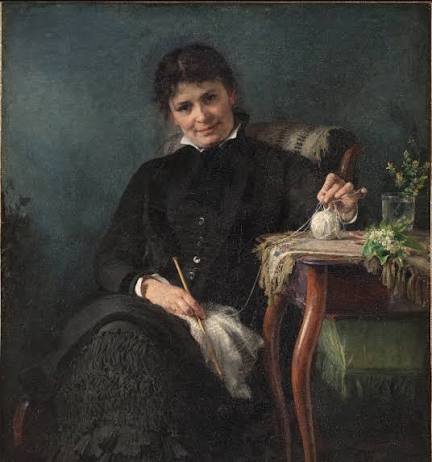 Bertha Wegmann (December 16, 1847 – February 22, 1926) was one of the most prominent and commercially successful Danish portrait painters of the late 19th century. Beyond
her exceptional talent, her life represents a fascinating chapter in queer art history. At a time when women were largely barred from official art academies, Wegmann
navigated a highly successful, independent path, sustained by profound personal and professional partnerships with other women—most notably the Swedish painter
Jeanna Bauck.
Bertha Wegmann (December 16, 1847 – February 22, 1926) was one of the most prominent and commercially successful Danish portrait painters of the late 19th century. Beyond
her exceptional talent, her life represents a fascinating chapter in queer art history. At a time when women were largely barred from official art academies, Wegmann
navigated a highly successful, independent path, sustained by profound personal and professional partnerships with other women—most notably the Swedish painter
Jeanna Bauck.
Born in Switzerland, Wegmann moved with her family to Denmark when she was five years old. Showing early artistic promise, she sought professional training, but Danish
institutions offered limited opportunities for women.
In 1867, she moved to Munich, a vibrant artistic hub, to continue her studies. It was here, around 1871, that she met Jeanna Bauck. The two women quickly realized they
shared not only an intense dedication to art but also a desire to live an emancipated lifestyle free from traditional patriarchal expectations.
Wegmann and Bauck established a shared home and studio in Munich, traveling together to Italy and eventually to Paris. Their relationship was a comprehensive life
partnership—often characterized by historians as a "Boston marriage" or a romantic partnership. They lived, worked, and traveled together for over a decade, leaving behind a
rich collection of letters that document their deep emotional and intellectual intimacy.
What makes their partnership particularly groundbreaking is how they documented their connection through their art. They engaged in a mutual "visual dialogue," painting
several radical portraits of each other that challenged how female artists were traditionally depicted.
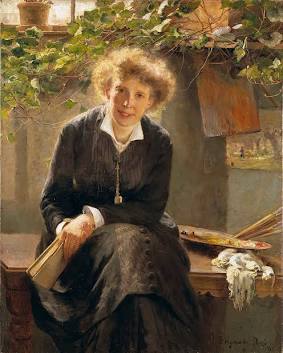
The Artist Jeanna Bauck (1881) by Bertha Wegmann
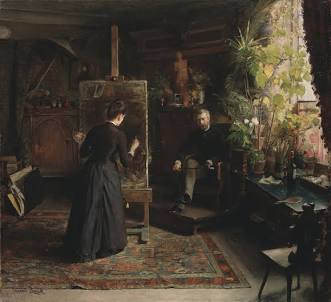
The Danish Artist Bertha Wegmann Painting a Portrait (1880) by Jeanna Bauck
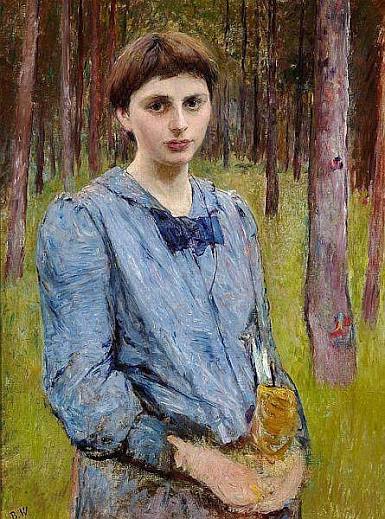
Bertha Wegmann: Portrait of a young woman in a blue dress. Presumably Bertha Wegmann's dear friend Toni Møller.
The Artist Jeanna Bauck (1881) by Bertha Wegmann: In this celebrated portrait, Wegmann depicts Bauck sitting in their shared Paris studio. Rather than posing passively,
Bauck is portrayed with striking intensity and intellectual presence, looking directly and confidently at the viewer. Her posture is relaxed, almost unconventional for the
era, sitting beside a table strewn with her painting materials.
The Danish Artist Bertha Wegmann Painting a Portrait (1880) by Jeanna Bauck: In a beautiful display of mutual support, Bauck painted Wegmann at work. It shows Wegmann
fully absorbed in her craft, painting a portrait of a male subject. This painting acts as a visual statement of professional agency: a woman artist confidently claiming her
space in the professional art world, captured through the loving lens of her partner.
In 1880, the couple moved to Paris, where Wegmann achieved significant critical acclaim. She exhibited at the prestigious Paris Salon, winning several awards, including a
gold medal in 1881 for her portrait of Jeanna Bauck.
Eventually, Wegmann returned to Copenhagen, where she became the first woman elected to the plenary assembly of the Royal Danish Academy of Fine Arts in 1883. Though she
and Bauck no longer lived in the same city full-time, they maintained their deep, loving connection and corresponded continuously until Bauck’s death in May 1926.
In her later decades in Denmark, Wegmann shared her home and her life with another lifelong partner, the artist Toni Möller. The
two lived quietly alongside their beloved dog, Fukki, and Wegmann captured their tender domestic life in several paintings.
Wegmann lived at the Kvindelig Læseforening (Women's Reading Association) building. The top floors of this prominent building functioned as a damehotel (women's
residential hotel/apartments) where female cultural figures and professionals lived.
Bertha Wegmann passed away in February 1926, just a few months before Jeanna Bauck. Today, their collaborative portraits stand as some of the most powerful visual records
of queer companionship and female professional solidarity from the 19th century.
References:
- https://en.wikipedia.org/wiki/Bertha_Wegmann
- https://www.facebook.com/groups/444196013953582/posts/924245755948603/
- https://grokipedia.com/page/bertha_wegmann
Support this project
This website is a passion project researched, developed, and funded entirely by me. If you find the content valuable and would like to help support the ongoing research and hosting costs, any contribution is deeply appreciated.
Thank you for keeping this independent resource alive!
My books on Amazon: Elisa Rolle's books
BACK TO HOME PAGE